The First Class Leaders Academy for pilots
You were trained to fly the aircraft. Nobody trained you to lead the crew.
When the pressure's on, or someone in the cockpit gets defensive, dismissive or goes quiet, it's easy to get pulled into their reaction and lose your next move. The Academy gives you a drill for exactly that moment, so you stay grounded and keep leading the crew.
Sixty minutes with Kyle on where you are now, where you want to be in six months and what's actually in the way.
Sound familiar?
It usually shows up in a moment like this
The captain snaps back at you and you go quiet for the rest of the leg.
You give a first officer feedback and the cockpit goes cold until you land.
You said nothing when you should have spoken up, then replayed it all night in the hotel.
Your upgrade is coming and you're wondering what kind of captain you're actually going to be.
Someone told you that you come across as too direct and you didn't see it coming.
There's one person you dread being paired with and you're carrying it home after every trip.
Your intentions were fine. They always are. But intentions are invisible. Impact is not.
The person you can't seem to fly with
Almost every pilot has one
Maybe it's the captain who makes every trip feel like a check ride, the first officer who goes silent when you need them most or the crew member who seems to take everything the wrong way. You've tried being patient. You've tried pushing back. Mostly you've been waiting for them to change.
Here's the part nobody tells you. You can't make another person change. The harder you push, the more they dig in.
What you can change is how you respond. That's where the real leverage is. It's also the part almost nobody in aviation was ever trained in.
Being right and actually leading are two different things.

Lighthouse, not tugboat
You can't push a crew where you want it to go
The tugboat
Pushing and pulling
When someone gets defensive or goes quiet, the instinct is to push harder or pull them back on course. You explain again, you correct, you nudge. It usually ends with both of you more dug in and you walking away thinking, I was just trying to help.
The lighthouse
Steady and clear
A lighthouse doesn't chase the ship. It stays steady and clear so the people around it can find their own way in. The best captains do the same under pressure. They stay grounded in what they control, so the crew has something solid to steer by.
The best leaders are lighthouses. We help pilots learn to become one.
Why this works
You train for the engine fire. Nobody trains you for the conversation.
You've drilled the engine fire in the sim until the memory items are automatic, so nobody has to invent them in the moment. The moments that go sideways with people get no drill at all. You're expected to just handle them.
Take the Lead is that drill. It's simple enough to remember under pressure and it never changes, so you always have somewhere to go. You learn to catch the moment, find your move and debrief it, the same way you'd debrief a flight.
Simple is what survives a startle.
Why it hasn't stuck before
Nobody learns to fly in a single day
Most of us have sat through a day of CRM or leadership training. You leave with good ideas and by your next pairing you're back in the same patterns because a day of training gives you ideas and leading people is a skill. Skills take time and reps, which is why you were trained in three parts and why we built the Academy the same way.
 1
Ground school
A weekly live group call and a short training video, where you learn a simple drill for the moments that heat up.
 2
The instructor beside you
A private hour with your coach every two weeks, built entirely around the real moments from your own trips.
 3
Reps in between
Coach access by text and the Copilot app, so you're practicing on real situations rather than just talking about them.
If this is you, read this part twice
You're not broken. You're untrained.
When a moment goes sideways, most of us defend. We point the finger out or we build the case for why we were right. It's a loop that runs before we've decided anything, like an autopilot nobody remembers engaging.
- Trigger
- React
- Defend
- Stagnate
Everyone gets caught in it, from first officers to chief pilots. The pilots who grow aren't the ones who never get caught. They're the ones who've been trained to notice it and choose again.
The First Class Leaders Academy
Six months of reps on the moments that actually matter
There's no big lecture day and no binder to read. You learn one simple drill called Take the Lead, then you run it on whatever is really happening in your work, with a coach beside you the whole way. It's a choice to focus on what you can control and learn from what you can't.
Catch the moment
Notice when something's off, even if you're already in the middle of it. That's the signal that you have a choice.
Choose one move
Take a real moment from your week into your private hour and build the one move you'll make the next time it shows up.
Take the action and debrief it
Try it when the moment comes back, message your coach in between and debrief it at your next session. Then go again.
What's included
- A private hour with your coach every two weeksAbout 12 or 13 sessions over six months, built around your real situations
- A ninety minute live group call every weekNormally Tuesdays and recorded if you can't make it
- Coach access between sessionsOn WhatsApp or text, for when a hard moment is coming up
- A weekly training video under ten minutesOne idea a week, short enough to actually watch
- The Copilot appA couple of minutes a day, so you're practicing and not just talking about it
- AssessmentsYour DiSC profile and debrief, Needs and Values and the Growth Index
- The Academy communityOther leaders working on the same thing
You may work with Kyle or one of the First Class Leaders coaches.
The honest promise
The promise isn't that you'll be perfect. It's that by the end of six months you've closed the gap between what you intend and the impact you have and you know how to keep closing it on your own.
Why six months? You wouldn't jump in an airplane and just know how to fly. Leading people is the same. It's a skill and it takes time and reps.
It's lighter than it looks. An hour every two weeks, ninety minutes a week live or recorded, a video under ten minutes and a couple of minutes a day in the app.
What six months looks like
You wouldn't jump in an airplane and just know how to fly
Leading people is the same. It's a skill and skills take reps. You won't see the whole shift in four weeks but you'll feel something move in your very first session.
Tap any stage to see what happens
You bring a real moment from a recent trip, like the captain who snapped or the briefing that landed wrong. With your coach you work out what was really going on and build the one move you'll make the next time it shows up.
You leave with a move in hand.
The weekly group call is ground school for Take the Lead. Between sessions you run the drill on your own moments, use Copilot for the daily rep and message your coach when something hard is coming up. Each private hour starts by debriefing what happened.
You start catching the moment sooner.
Once the drill is in your hands, your DiSC profile and debrief show you how other people experience you. It helps explain why the same words land one way with one crew member and another way with the next.
You see your impact the way your crew does.
You keep running reps on whatever your trips bring, from the upgrade coming up to the pairing you dread. The goal is that by month six you can catch the moment, choose your move and debrief it on your own.
You know how to keep closing the gap yourself.
What changes
The same moments, a different response
The hard moments don't stop showing up. What changes is what you do when they do.
Small and soon beats big and never.
In their words
What pilots say after the work
A must for anyone embarking on an Airline job or a management job. I have 35 years of Flight Instructing experience and over 13,000 hours and I learned so much from this course.
First Class Leaders is an incredible opportunity for anyone who wants to improve their interpersonal skills. Especially those transitioning into a leadership role.
This course will have a positive impact on how you approach interactions at work and throughout your daily life.
This type of training is missing in the pilot world.
Is this for you?
Rank has nothing to do with it
This is for you if
- You can name a specific moment in the cockpit where the impact you had wasn't what you intended
- You're a first officer working toward the left seat, a new captain, a check pilot or a chief pilot
- You know you can fly the airplane but something's missing in how you lead the crew
- You're tired of replaying conversations long after the trip is over
- You'd rather work on your own next move than wait for someone else to change
It isn't for you if
- You're looking for a quick script rather than a skill
- You mainly want help proving someone else is the problem
Flying with fewer than 1,500 hours? The Academy is built for pilots past that point, so start with the Copilot free trial instead. It's the same drill and it's there whenever you need it.
The first step
What happens on a Clarity Call
It's sixty minutes with Kyle, built around three questions.
- 1Where are you now?
- 2Where do you want to be in six months?
- 3What's actually in the way?
You'll leave with a clearer picture of all three whether you join the Academy or not. If it's a fit, we'll talk about what working together looks like. If it isn't, Kyle will point you toward something that is.
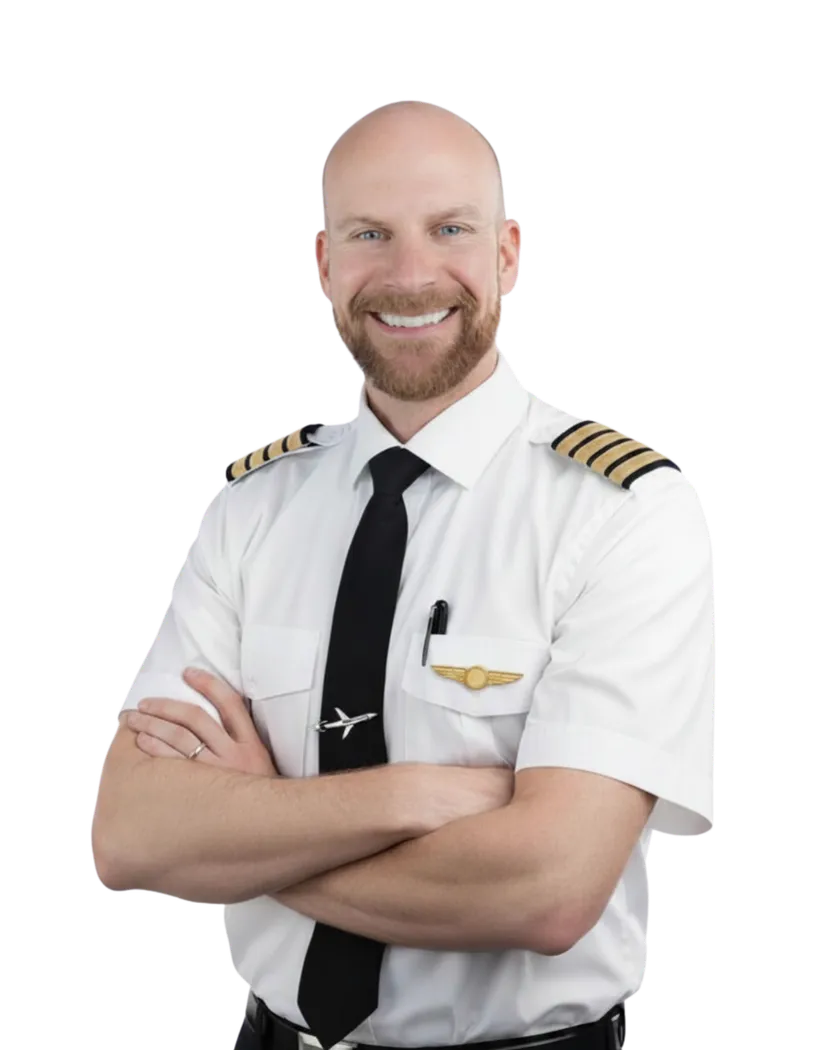
Book your Clarity CallKyle has been flying for over 20 years and has a little over 10,000 hours of what he likes to call lessons learned, first as an Air Canada captain and now as a Gulfstream captain.
Not ready to talk yet?
Start with the drill on your own
Copilot app
Your intentions are good. Your impact doesn't always agree.
Everybody knows what good leadership looks like. The challenge is showing up that way when you're under pressure or someone else isn't at their best. Copilot helps you find the move for those moments. Try it free for 30 days with everything open and no card required.
See how Copilot works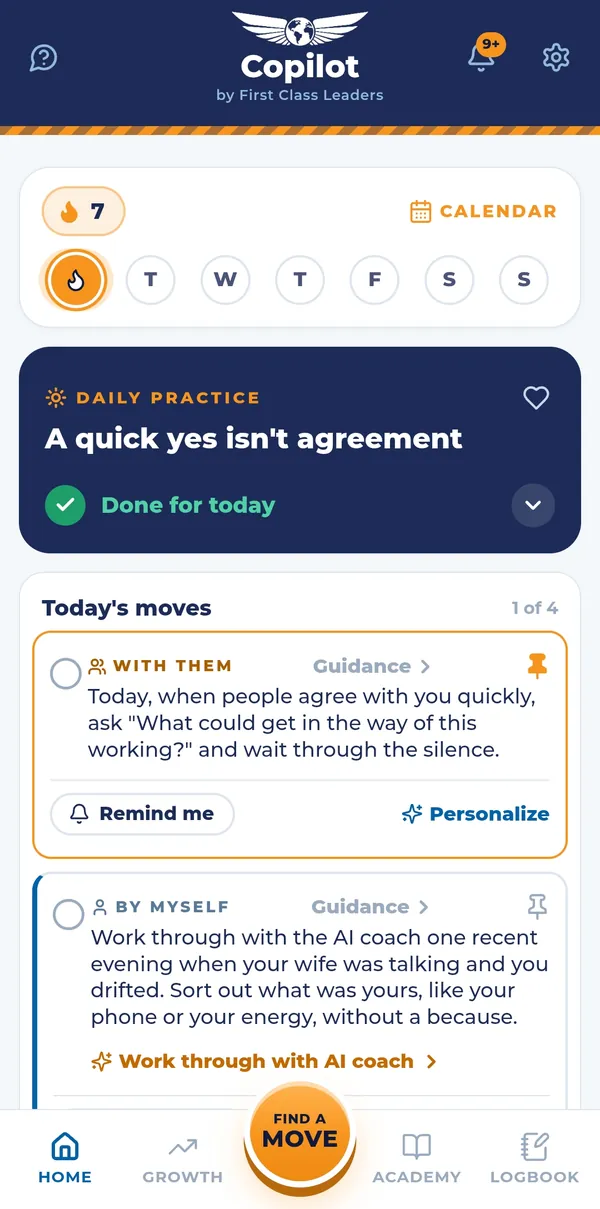
The podcast
Real leadership moments, one episode at a time
New every Tuesday. Kyle and his guests break down the moments that go sideways with people and the drill for choosing your response.
Listen to the podcast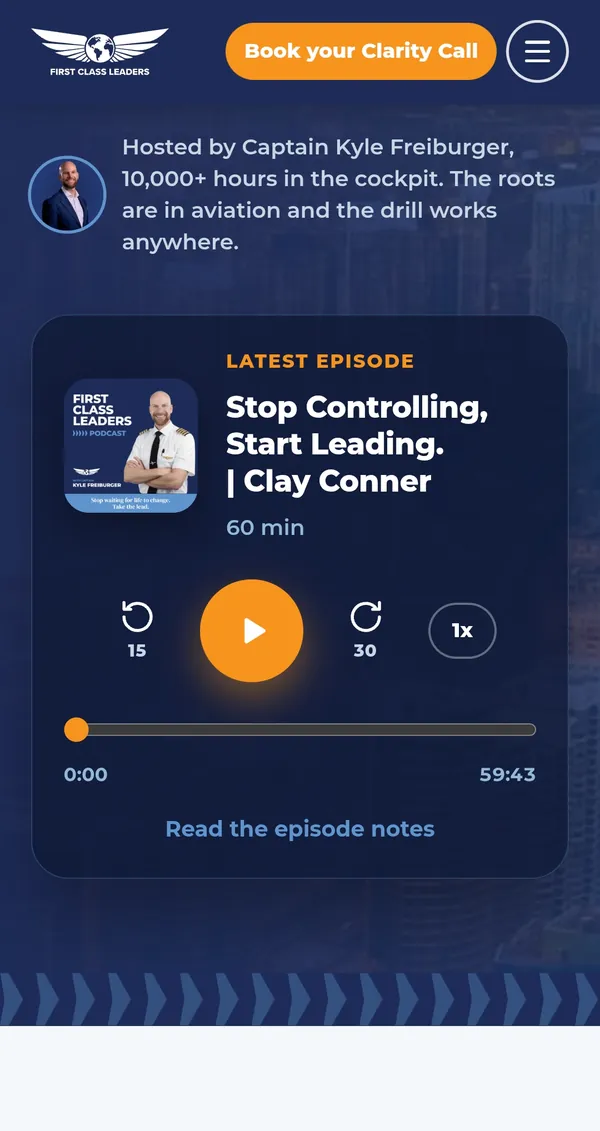
For chief pilots and flight departments
Prepare your first officers to lead before they upgrade
Your best first officers get the left seat because they're great at flying the airplane. We give new captains and future captains a common language for owning their impact, so they're ready to lead the crew before they formally step into the role.
Talk to us about your pilots
There's always another rep
The next tense moment in the cockpit is already on its way. You can meet it the way you always have, or you can walk in with a move you've chosen ahead of time.
Book your Clarity CallSixty minutes with Kyle on where you are now, where you want to be in six months and what's actually in the way.